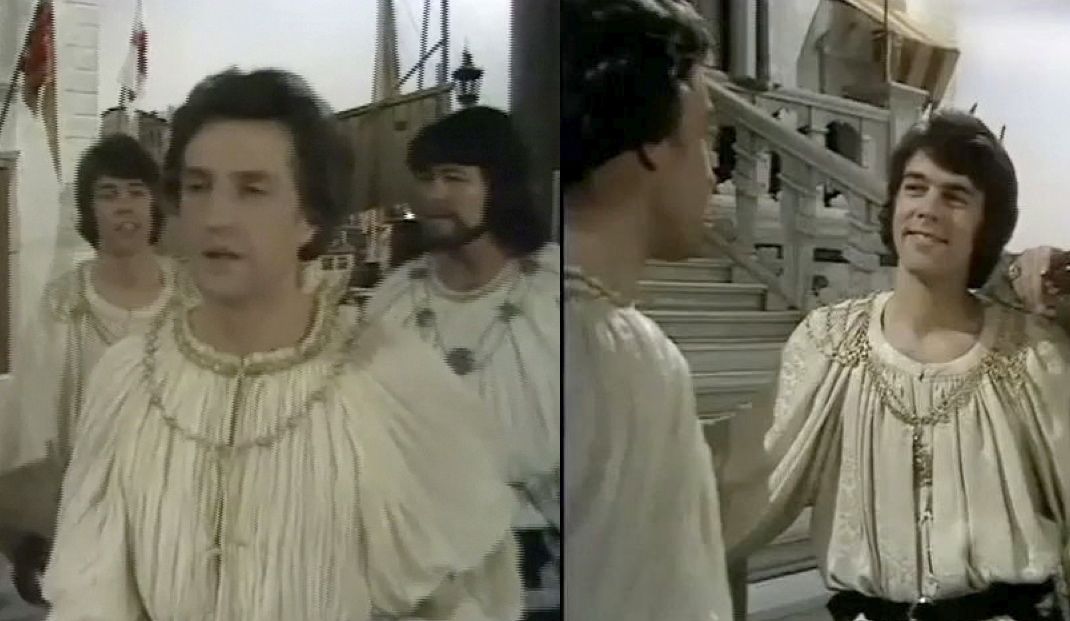
Self-portrait

Self-portrait

27 November 2011

SOUND BYTES

Yet there are moments when the walls of the mind grow thin; when nothing is unabsorbed, and I could fancy that we might blow so vast a bubble that the sun might set and rise in it and we might take the blue of midday and the black of midnight and be cast off and escape from here and now.
Virginia Woolf, The Waves (1931)

Photo by EP

Photo by EP
I have been searching through over fifty years of unsorted sound; my backlog of cassettes is a chaotic Tower of Babel, containing chanted lines of old parts, family recordings of Christmases past and golden summers. I even have some tape over forty years old of my elder son. There is dictation from the days before I taught myself to type, and of course the odd radio play. Actually Emily has a very thorough set of her old radio plays. I still remember her wonderful rendering of the line ‘Take me home’ at the end of Michelle Magorian’s Back Home (1995), which recently, on waking, I heard repeated on the radio and which you can hear in my homemade radio talk One’s Own Voice.

This afternoon I decided it would be a treat to hear Bernard Shaw’s play Candida, with Hannah Gordon in the title role, Christopher Guard as the young poet Marchbanks, and myself as the Reverend James Morell. The performance was first broadcast on Radio 4 in 1977 and I find it has been repeated no less than seven times in the last two years on Radio 7 and Radio 4 Extra, without my knowing! My treat was to sit with the afternoon sun pouring through the windows, Shaw’s astringent, witty and sometimes very touching dialogue pouring out of my battered old radio cassette player whilst I finished off my painting of The Allegory of Acquaintance.

Photo by EP

It strikes me that Candida, the ideal woman whom everybody is in love with, and Marchbanks the young poet are genuinely, refreshingly ‘new types’ and remain so. Gordon and Guard are superb. It strikes me, too, what a world of difference there is between Wilde’s Canon Chasuble (whom I’m currently rehearsing) and Shaw’s Reverend Morell, both in their own ways unique as well as being clerical clichés, both in love, both delightful to play. I am disappointed in Shaw for not appreciating The Importance of Being Earnest, but the light touch and the emotional imagination with which he creates the story of his characters in Candida is wonderfully alive.

Athene Syler played Miss Proserpine ‘Prossy’ Garnett on stage in 1937, and told me in her ninety-ninth year that, in the scene where she is tipsy, having tasted champagne for the first time, Shaw wanted her to trip over the mat on her exit. ‘I refused to do it’, she said. ‘“I’ll show you what I’ll do”, I said. And I made for the door from down left to up centre in a sort of controlled curve and got a round every night!’

As I listened, and painted, I imagined … well the play of course, all oddly familiar yet coming as a series of dramatic surprises, and Shaw himself walking up the road to our local train station, which, as we know from his diary, he did at least once. And I read the other day in Trent’s Own Case, the 1936 whodunit written by E. C. Bentley not five minutes’ walk from the same station, his Police Detective Bligh describing Shaw as his favourite ‘literature of escape’ – a phrase coined by a gaolbird who recommended Shaw to the detective:


‘I had to interrogate a prisoner some years ago about a certain matter. A confirmed criminal he was. They used to call him Pantomime Joe, on account of the cheek he used to give everybody from the dock … Joe was an educated man, and it was no surprise to me, when I visited him in his cell, to find him reading a book from the prison library. He showed it to me – Plays Pleasant, by G. B. Shaw. “What’s this?” I said. He grinned at me. “This is the literature of escape, Blighter,” he says, using a silly nickname he and his sort have always had for me. I thought that sounded a funny sort of reading to be put in the hands of a man who spent half his time in gaol, but he explained his meaning.’
‘And what can that have been?’ Trent wondered.
‘Why,’ the inspector said, ‘Joe meant, and I agree with him, that Shaw takes you right out of the beastly realities of life. I can tell you, after a hard day at our job, with all the spite, and greed, and cruelty, and filthy-mindedness that we get our noses rubbed in, it’s like coming out into the fresh country air to sit down to one of Shaw’s plays. … And there’s never a dull moment. Every dam’ character has something to say; even the stupidest ones. … Who ever had the luck to listen to anything like it in real life? I tell you, it’s a different world.’


The recommendation charmed me and I realized this afternoon how fresh an escape Shaw still is, and the characters all do have something to say and say it so well. True escapism, as I observed only last week in speaking of A. L. Kennedy’s The Blue Book, never lets you go.

And talking of prison and libraries, I’ve been re-reading Oscar Wilde’s letters to the Daily Chronicle, written after his imprisonment, with his plea that prisoners should be provided with good books:

Deprived of books, of all human intercourse, isolated from every human and humanising influence, condemned to eternal silence, robbed of all intercourse with the external world, treated like an unintelligent animal, brutalised below the level of any of the brute creation, the wretched man who is confined in an English prison can hardly escape becoming insane. (23 March 1898)

The painting is an attempt at mythography, inspired by Titian, and – as in Titian’s Allegory of Prudence – there will be a Latin motto added by next week. It is a story of another West Hampstead happening: our dog effecting an introduction to one of our notable elderly characters who recounted tales to me of his young and exotic self. I had seen him about the place for twenty-eight years but never spoken to him until Bean introduced us!

Photo by EP
Postscript
You might like to visit the newly styled homepage of Peth’s Staging Post which features a lovely new portrait of Edward by Bronwen Sharp.
KR

21 November 2011

A GENTLEMAN'S GENTLEMAN

Make me thy lyre, even as the forest is:
What if my leaves are falling like its own!
The tumult of thy mighty harmonies
Will take from both a deep, autumnal tone,
Sweet though in sadness.

Shelley,  ‘Ode to the West Wind’ (1820)


Season of mists ...

and mellow fruitfulness. Photos by EP


SUNDAY, 20th NOVEMBER

It has saddened me on this perfect autumn day to hear from Harriet Walter that Richard Morant, who of course played Bunter in our Dorothy L. Sayers Mysteries, has died at the age of sixty-six.

Actors make so many transient, relatively intimate working relationships with one another and, so often, move on. I had only come into chance contact with him once since those days and, as usually happens, we took up the reins of our good humour and comradeship as if we had just finished a scene together.

The first time Richard and I worked together was in a BBC TV 
production of The Merchant of Venice. I played Lorenzo and he Solanio.

I do not recall from 1986 that we discussed the relationship of officer and batman in the trenches as it developed into man-about-town and gentleman’s gentleman, amateur sleuth and technical assistant. The books had given us chapter and verse and we seemed to come to an understanding, a modus vivendi by some process of osmosis. We developed a supreme tact between us. I remember something about Richard that seemed reliable, benign, with always the twinkle of a possible smile.

Here is just a handful of our scenes together. In the one in which I am tying my bow tie, I remember we made up most of our dialogue.

14 November 2011

BLUE NOTES

And they buried him in the citie of David among the kings, because he had done good in Israel, both towards God, and towards his house.
2 Chronicles, 24:16 (1611 King James Bible) 


Photo by EP
Some mornings this last week have been grey and the poor shred of a no longer protected ancient orchard, hemmed in by the local railway line and overrun with Japanese knotweed, was hardly visible and more disregarded than ever.

The train journey to Barnes for Importance rehearsals is convenient in theory but often very long in practice. Never mind! Since A. L. Kennedy mentioned and quoted from my book, Slim Chances, on her Twitter page on 27 October, I have sought out and been reading on my Kindle her latest novel The Blue Book and thus enriching my daily commute no end. In fact I have often been annoyed at the disruption caused by my arrival at Barnes station.

Photo by EP
It is one of those almost folly-like stations, Victorian cottage Gothic with impressive chimneys.

The strange, delicately intense – hopeless adjectives –‘fierce’ would do as well and still convey nothing of the world of The Blue Book … anyway it is a world that has been separated from Wilde’s Act 2 and the charms of Cecily’s garden by a ten-minute walk through Barnes Common, which is pleasant enough in the mists but positively uplifting when the summer decides it is not yet over.


Photos by EP
Failing sunshine, there is nothing like a good couple of hours of a full-cast singing rehearsal to lift the heart.

Actually I thought it might not be too late to lift the spirits and take up Tai Chi this morning when I was observing a local exponent on the edge of our green. Tai Chi is related to the martial arts, but a world away from the martial deportment I had been watching in the Remembrance Day ceremony minutes before, televised from Whitehall.


The remnants of the foundations of a WWII air raid shelter were dug up on the green recently; hardly anyone knew what they were. I happened to notice a Jewish boy happily kicking a football nearby.

Photo by EP
On Saturday night in Trafalgar Square, when I emerged from a late-night viewing of the Leonardo da Vinci exhibition, there was another exhibition of grace on the wide pavement in front of the National Gallery Portico.


Kathleen reminded me today that the Tomb of the Unknown Warrior is the only tombstone in Westminster Abbey’s floor that one cannot walk over.

I remembered a moment from The Blue Book which I will dare to quote here: 
They used to say that there was one time when a king would have to salute a private soldier and the soldier could ignore him – which is when the private soldier is dead.
The Burial of the Unknown Warrior. Painting by Frank O. Salisbury, 1920
King George V and, behind him, the Prince of Wales (later Edward VIII),
the Duke of York (later George VI) and Prince Henry.

05 November 2011

BITS AND PIECES

Without assuming that the world, or a tiny fraction of it, awaits my weekly blog, I feel I ought to post something, come what come may, by each weekend. I have done two days of research and development on the King Lear project, and start rehearsals for the musical of Oscar Wilde’s The Importance of Being Earnest on Monday: perhaps I scribbled whilst Rome burned, attempting a drawing class the other morning … I say if a job’s worth doing it’s worth doing not very well, as long as it’s the best you can manage at the time.


The art school is the former home of a forgotten but once famous late Victorian and Edwardian playwright, Henry Arthur Jones. Kathleen tells me that Oscar Wilde quipped: ‘There are three rules for writing plays. The first rule is not to write like Henry Arthur Jones; the second and third rules are the same’.

The top-floor studio of Hampstead Art School in Kidderpore Avenue.
Photo by EP
Saw Arthur Miller’s Broken Glass on Friday night, done superbly well. It was for me a somewhat late conversion to the extraordinary talent of Antony Sher.

The children used to like a supper called bits and pieces; my diet has included this last few days bits and pieces too numerous to mention and piecemeal work on my painting. Here’s a hasty snap of work in progress showing a stab at the young Oliver Cox. One of Kathleen’s last achievements before flying back to Sydney on Saturday night has been to Latinize my motto for the ‘Allegory of Acquaintance’: canis meus erat qui me in hunc antiquum militem induxit, triginta annos hospitem exoticum (‘It took my dog to introduce me to this old soldier, thirty years an exotic stranger’).


And talking of bits and pieces, I end with an attempt in sonnet form to justify my temerity in approaching Lear:

How can one have the courage to approach
The magnitude of Lear’s history
And yet the actor’s pride’s beyond reproach
For all the play’s great depths and mystery
Its raw, severe and storm-lashed language springs
Alive on to the paper to be spoke
Its tender limpidness so gently wings
While limps and swerves the Fool’s dry bitter joke
All tailored to the actor on the stage
To strut his flawed path, recognized and shared
By followers in youth and seasoned age
The audience, all captive and ensnared
All bound by mere pretence and play, to see
That pity for a while can set us free.

Benjamin West’s depiction of Lear and the Fool in the storm scene, 
commissioned for the first illustrated edition of Shakespeare’s plays - 
a project conceived in Georgian West Hampstead.

31 October 2011

BLOG 100

A modern house, he saw, perhaps ten years old. The place was beautifully kept with that air of opulent peace that clothes even the smallest houses of the well to do.
E. C. Bentley, Trent’s Last Case 

I was touched when some of my regular readers sent messages. There had been an unexplained long lull in my so-called weekly postings and the messages expressed the hope I was well. I responded to them and then posted my ninety-ninth blog.

I must not be intimidated by the task of this, the hundredth. At least I have some news and have the delicious chance to be thinking about two plays at once, the greatest tragedy in English and what many think of as the most perfect comedy. It may not be wise to tamper with perfection but, from the moment I heard the duet for Miss Prism and Canon Chasuble in a new musical version of The Importance of Being Earnest, I was smiling away my last scruple. This is the week in which I will have my first rehearsal of that duet with Susie Blake and meet with Paul Hunter under the joint auspices of the RSC and his company Told by an Idiot, just the two of us in duet form to tamper with and explore the colossal structure of King Lear.

My younger incarnation of Dr Chasuble, for the Actors’ Company in 1977.
Photo by Sophie Baker 
Meanwhile I have been preoccupied with the research into West Hampstead, or should I say Kathleen’s research. I said to her last week, on the strength of the breadth of her discoveries, that perhaps our book should be called West Hampstead – Hub of Empire, and that was before she discovered that Cecil Rhodes in 1873 bought ten new brick houses ‘prettily situated’ three minutes from West Hampstead Railway Station; he was twenty years old and had capital made from Kimberley diamonds he wanted to invest. We need to discover which houses they were and whether one of them was the house in which E. C. (Edmund Clerihew) Bentley wrote Trent’s Last Case, the detective novel which was the inspiration for the Peter Wimsey stories of Dorothy L. Sayers. 

Bentley’s house in Lymington Road. Photo by EP
E. C. Bentley by Hugh Goldwin Riviere, 1915.
National Portrait Gallery

Bentley was a groundbreaker, introducing not only the idea that his hero was not a superhuman mastermind but also a man involved in a romantic love story within the complexities of the plot. It was a plot, we are told, he worked out on his daily walks from West Hampstead to Fleet Street where he was a leader writer for the Daily Telegraph. It was no doubt easier to be creative and think strategically in the London streets circa 1911 with only the noise of horse traffic, even though there were twice as many Londoners as had been counted in the census of 1851. 


‘Traffic’ at West End Green, circa 1905

What would Bentley think of me now, not walking but Tubing it into the centre (as he could have done of course), but thrilling to his astonishing twists and insights in electronic form on my Kindle? What would he make of the Dog Roses I managed to ‘paint’ on my iPhone as I sped underground to play Sophocles’ Tiresias near London Bridge, a painting inspired by the blooms in the cemetery he too must have known.  


Postscript
Bentley was also the inventor of the ‘Clerihew’, which The Poet’s Manual and Rhyming Dictionary defines as ‘a humorous pseudo-biographical quatrain, rhymed as two couplets, with lines of uneven length more or less in the rhythm of prose.’ And so I leave you with my very first clerihew:

Trent’s Last Case, by E. C. Bentley
Was the first case to introduce love themes, very gently.
In similarly tender hue
I dedicate this clerihew.

23 October 2011

TIME PRESENT AND TIME PAST

               Through the sweet-briar, or the vine,
               Or the twisted eglantine;
               While the cock with lively din,
               Scatters the rear of darkness thin.
                                                                     Milton, ‘L’Allegro’

 The Metropolitan railway bisects West Hampstead terraces.
Photo by EP


I believe I am coming up to my hundredth blog, though I admit the title ‘Weekly’ has been a misnomer lately. The truth is I have been leading a double life, which takes twice as long as a straightforward single one. I doubt that any of you lives such a simple thing as a single life, however blameless you may be. 

I can’t walk or bus about London NW6 where I live without musing about the people who lived here before me and the delicious names of the places where they walked, so that I am half in the present and half in a series of pasts. Who could not wish that this dense, brick-built suburb of London still had a turning called ‘Sweetbriar Walk’, or that the young Queen Victoria could still be seen strolling between the hawthorn hedges bordering the meadows of West End Lane, having taken a drive in her horsedrawn carriage from her palace, up what was once the ancient Roman Watling Street. Walking to the Tricycle Theatre in neighbouring Kilburn the other night to see a play, in Kilburn High Road, aka Watling Street in fact, we passed a house where the Vorticist painter David Bomberg lived in the 20s and 30s, and I marvelled again, not only that this railway-riddled suburb was once the subject of Constable’s sylvan idyll with a shepherd lad, but that its dense regimented terraces of houses has not succeeded in creating regimented people. 

If we think of West End Green as a suburban vortex (it began life as a village green and is now a traffic island for all its stately plane trees), then a mere 500 yards up the road there is a little vortex of history in our kitchen formed by three fridge magnets: Romney’s Lady Hamilton (fancifully portrayed at the spinning wheel), c. 1785; Bomberg’s ‘Mud Bath’ of 1914 - both artists we know traversed the Green; and our magnetic London Underground bottle opener, reminding us of West Hampstead’s Tube station opening as early as 1879, harbinger of Bomberg’s mechanized future which fractured Romney’s handmade past. 

 Photo by EP

As Ezra Pound, another quondam habitue of West End Green, put it: ‘All experience rushes into this vortex. All the energized past, all the past that is living and worthy to live. All momentum, which is the past bearing upon us, race, race-memory, instinct charging the placid, non-energized future.’

Kathleen Riley, who has been editing this blog from the other side of the world in Sydney, but is now here, walked with us into the grime and noise of nearby Kilburn High Road last night to see the Cold-War play A Walk in the Woods, and there we were in another past, the Geneva woods, fascinated by two nuclear disarmament negotiators, one Soviet, one American. We had done the same journey the night before to the Tricycle Cinema to see Woody Allen’s Midnight in Paris, which took us in enchantment to a world before the moon had been reached or The Bomb dropped. 

As we walked back home we were not three minutes’ walk away at one point from the 1920s house where until only six years ago the Nobel Peace Prize laureate Professor Joseph Rotblat lived. Having worked on the Manhattan Project to create the first atomic bomb, he pulled out and eventually concentrated on harnessing nuclear radiation for medical purposes, meanwhile founding, with Bertrand Russell, the Pugwash Conferences, following the Russell-Einstein Manifesto of 1955, which sought to urge international leaders to resolve their disputes through peaceful means. 

 The ‘semi-detached’ house on the left is Rotblat’s former home in Asmara Road and the unlikely headquarters of the Pugwash Conferences. 
Photo by EP

The week before we’d walked past the L-shaped Annesley Lodge on the corner of Platt’s Lane and Kidderpore Avenue, designed by C. F. A. Voysey in 1896, an Arts and Crafts breakaway from late Victorian brick-built conformity. Voysey’s father, the Rev. Charles Voysey, for whom the house was built, was also a breakaway from conformity; he was condemned by the Privy Council for heresy, having denied the doctrine of everlasting hell. What would he have thought of the unimaginable man-made hell, discussed endlessly in the Geneva woods and in the West Hampstead headquarters of the Pugwash Conferences?

 Annesley Lodge. Photo by EP

So you see we walk through our research every day as well as trawling the internet and delving into the archives of local history. Along the way we encounter poets, painters, parliamentarians and peace-brokers, magicians, musicians, magnates and modernists, conjurers, clowns and clerics, harlequins, hypnotists and heretics …

Photo by EP
There may be no time like the present but the past is currently our parallel universe. This morning we even walked on a pavement bordered by a descendant of sweet briar on our way to the old railway sidings, now a Peace Park, where we read the words of a Mayor of Hiroshima inscribed on a paving stone.

 Photo by EP. (Click to enlarge image)

02 October 2011

VOICES ON A WARM OCTOBER NIGHT

There is no index of character so sure as the voice. 
Benjamin Disraeli

October 1st, 2011: I took this photograph on my iPhone just after 7 o’clock this evening, so you see how our London nights are drawing in, though our day was perfect, breaking all records for October – and it promises to be at least 80 degrees Fahrenheit again tomorrow. This corporate steel and glass rises at the junction of Hampstead Road and Tottenham Court Road.

Photo by EP
Its humble nextdoor neighbour is a modest brick building with a door leading to a tiny fringe venue, the Camden People’s Theatre, where a company called Improbable were doing the second of two nights of their latest improvised experiment in The Still.

Photo by EP
I had a particular reason to talk my way into tonight’s sold-out performance; I had met the director Phelim McDermott at the nearby Pret a Manger for lunch yesterday along with Paul Hunter, my clown companion in The Fantasticks. We were discussing the forthcoming workshop Paul and I are doing on the subject of King Lear, and hoping Phelim would be able to join us in our experiments.

Myself as Henry and Paul Hunter as Mortimer in The Fantasticks. 
Duchess Theatre 2010. Photo by Francis Loney

As it turned out, tonight was more relevant than I could have hoped because the noted ‘Voice Dialogue facilitator’, John Kent, was interviewing the voices of the actors … well, I gather we might all have many voices, many people that we are, but it was fascinating to hear improvised interviews with two selected selves of each actor, as they strove to explain their function in, and their relationship with, the lives of the main self (whose seat was left vacant whilst the other self stood aside and did the talking, if you take my meaning.

According to Improbable’s website: ‘Pioneered by Drs. Hal & Sidra Stone, Voice Dialogue is a revolutionary process that allows us to become aware of the many different selves that influence the course of our lives.’ This technique is used in the corporate world of glass and steel as well as in experimental fringe theatres.

There was, of course, a more successful element of performance, not to say comedy, in the excerises than one might have expected had we been next door with executives on a development course. Even Matilda Leyser’s baby to be was a prominent character. Phelim’s two poles were a rather puckish, sly mischief and a hangdog shamed reluctance; hers, no less physically manifest, fidgety retreats into laughter and four-square, no-nonsense career woman. But, despite this element of performance, there was a sense of honest inquiry and revelation in the experimental proceedings.

I began to wonder to what degree a king might be himself part-fool and take the advice and criticism the fool is licensed to give, and conversely, a fool part-king. Most of all I began to wonder about the authentic voice, which of one’s many voices was the one to be attended to. For the actor, when attempting to take on the mantle of another person, the problem is further complicated. I found the authentic voice so difficult to find as I sat at my kitchen table saying Lear’s lines, attempting to honour the poetry, the rhythm and yet discover, too, the cadences of ‘natural’ speech, in fact to make King Lear – as I might say – one of me.

Lear and the Fool. Double self-portrait.
Charcoal on paper, 2006
My work on King Lear was begun whilst there were snowdrops in Hampstead Churchyard in very early 2007. Hence this rejected attempt at fulfilling a commision to supply my Lear in image form for publicity purposes before I quite knew who he was.

Photo by Arthur Petherbridge
I am intrigued by news of some distinguished voices that sounded just ten minutes’ walk away from my kitchen table, and not far from Hampstead Churchyard, albeit a century ago. Ernest Rhys, founder of the Rhymers’ Club and the Everyman’s Library of classics, recorded this extraordinary tale of a most memorable literary encounter in his West Hampstead home:

Ernest Rhys
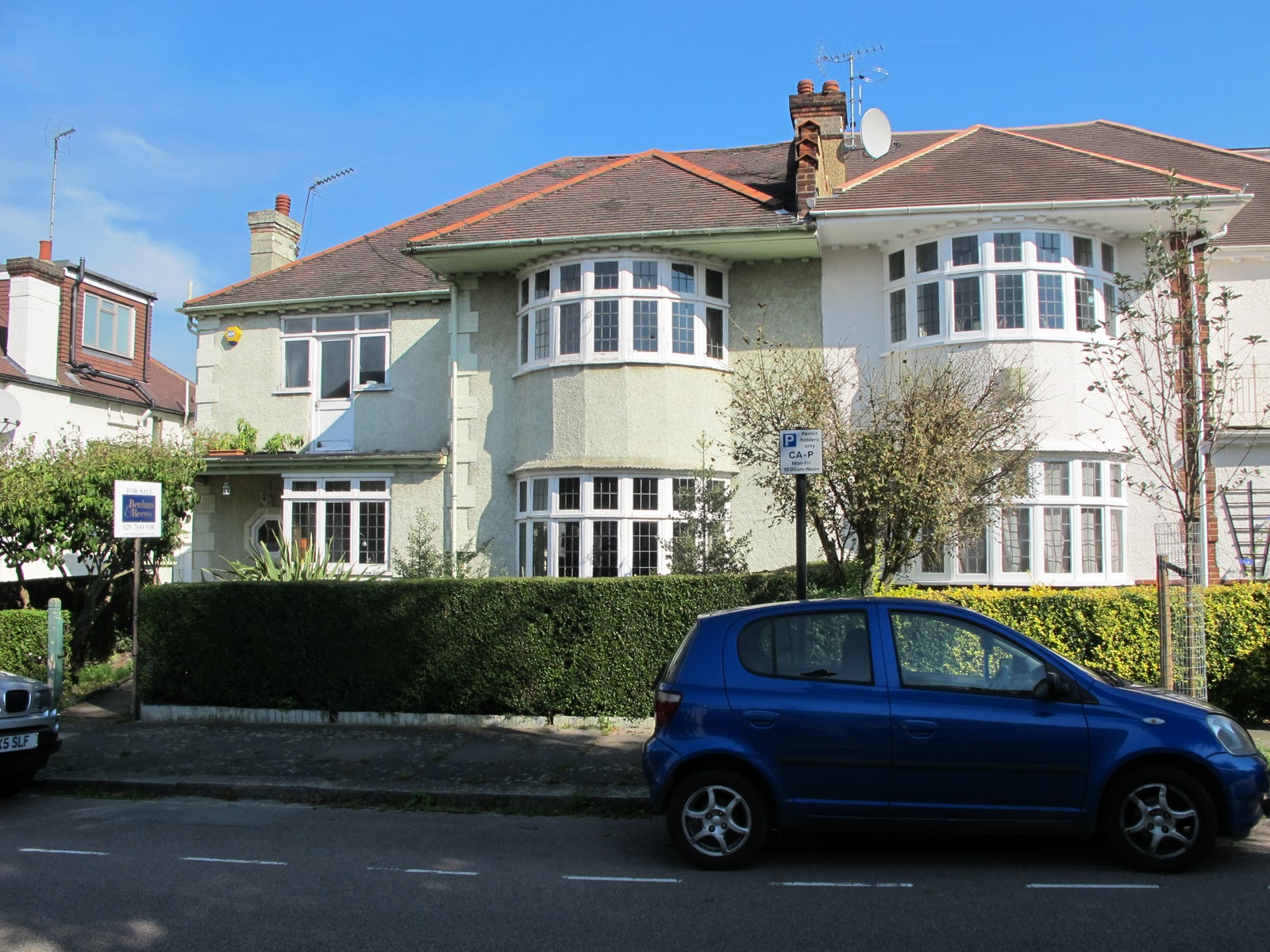
At our house in Hermitage Lane – called ‘Derwen’ after the old oak tree staring in at the window – to which we had moved from Hunt Cottage, we often had gatherings of young poets, resuming the nights at the Old Cheshire Cheese of the Rhymers Club. …

The most memorable of these nights was one when the late D. H. Lawrence, then a completely unknown poet, came with Ford Madox Ford (who was editing the English Review). He had written to say he had discovered a wonderful new poet in a young country schoolmaster somewhere in the Black Country, and wished to bring him along. …

When the two entered the room together, they made a strong contrast. Ford always had the air of a man-about-town used to town occasions, while Lawrence looked shy and countrified; perhaps a little overwhelmed by the fanfaron of fellow poets heard in the room, with W. B. Yeats and Ezra Pound dominating the chorus. …
‘Derwen’ today, complete with oak.
Photo by EP
During the supper, Yeats, always a good monologuer, held forth at length on this new way of bringing music and poetry together, and possibly Ezra Pound, who could also be vocal on occasion, may have felt he was not getting a fair share of the fun. So, in order to pass the time perhaps, and seeing the supper table dressed with red tulips, he presently took one of the flowers and proceeded to munch it up. …

The plan of entertainment on these occasions was a simple one. Every poet was supposed to bring an original poem and read or declaim it aloud. Willie Yeats was a capital opener of the feast, and that night we asked him, as he said he had no new verses to read, to recite ‘The Lake of Innisfree’; but he said he was tired of that lovely lyric, and read us instead a later one which begins:

‘She lived in storm and strife,
Her soul had such desire
For that proud death may bring …’

Rhys continues his account of the evening at some length and says that Pound, sounding like Henry Irving with an American accent, declaimed his Ballad of the Goodly Fere.

I sat at my own kitchen table and listened, via the online Poetry Archive, to Yeats intoning ‘The Lake Isle of Inisfree’ and Pound his Cantos. They both seemed to believe that poetry came from a different place and had to be chanted with fulsome vibrato and a small range of notes as in an incantation or prayer. I now wonder, as they slipped in and out of this manner of speaking round the supper table, if they consciously became at one moment The Poet and at another the man again. Nowadays one would be embarrassed to be caught out speaking in a ‘poetry voice’. But isn’t it strange that grown men of genius could sit round a table and allow the poet in them to speak so portentously, religiously when we know that the poems are much nearer to our common lives than that, and sound, for all their word music and wonder, just like the real us.