Self-portrait

Self-portrait

31 December 2011

WHAT'S IN A NAME?


I regard the theatre as the greatest of all art forms, the most immediate way in which a human being can share with another the sense of what it is to be a human being. 
Oscar Wilde

iPhone self-portrait by EP

Two weeks ago a lady sweetly accosted me at the Riverside Studios after a performance of The Importance of Being Earnest and told me she would remember my Dr Chasuble’s attempt to imitate a buzzing bee, in my duet with Miss Prism, to her ‘dying day’.

I imagined that nobody remembered my young Algernon Moncrieff from the New Zealand Players’ production of The Importance of Being Earnest in 1959, and I may well be right. The following memory, recounted in an email I received the other day, is appropriately described as ‘quirky’:

My niece and I saw your matinee yesterday and loved it all. … One quirky memory which might amuse you. I had no idea of who the cast were when we came yesterday, on the spur of the moment, and when I saw your name it took me back to 1959. I remembered I had rather taken your name in vain, back then in Blenheim, New Zealand, when I was an 11-year-old schoolboy. On the day in question our teacher had required us to perform an adlibbed impromptu and entirely unrehearsed sketch of whatever we chose and I was, I think, in the role of some kind of interviewee. I was asked my name, and I had to adlib, in character. The context required something rather grandiloquent and magnificent and I blurted out ‘Edward Petherbridge’. I got a big laugh from my classmates, and I remember feeling very guilty that I had got the laugh on false pretences because it was actually a real person’s name, whose feelings might be hurt, and it was not right to get a cheap laugh. I think I can recall that I had just been taken by my parents to see the NZ Players and that it must have been the name of one of the actors in whatever it was we then saw. My niece, to whom I recounted this yesterday, has subsequently Googled and found that it was indeed you and that you were playing Algernon! So can I now apologise, after 52 years, for my impertinence. It is just possible, of course, that you have been unaware all this time of this lese majeste. 

The cast of The Importance with Wilde’s grandson Merlin Holland.
Photo by Francis Loney

Happy New Year to all my readers and to the people who unwittingly provided me with this New Year card of white winter roses in the gloom outside their interesting West Hampstead window; lese majeste again, as an Englishman’s home is his castle!

Photo by EP

25 December 2011

THE REAL MIRACLE

To me, every hour of the light and dark is a
     miracle
every inch of space is a miracle.
Walt Whitman
                                   To prove
Our almost-instinct almost true:
What will survive of us is love. 
Philip Larkin 

Imagine a Gothic chapel in the snow. Well, I say Gothic – late nineteenth-century. It’s a cemetery chapel, quite near our house, and it was done up for Christ’s birthday, as it were, last year, with candles and a bit of holly and, I think for the first time, a carol concert was held in it. I wrote this occasional poem:


Note: John Clement Bell, of Clayton and Bell stained glass, lived in Kingdon Road, West Hampstead and is buried in our local cemetery. Sir Walford Davies, who succeeded Elgar as Master of the King’s Musick, lived in Fawley Road, whilst his friend Frederick Rothwell, who, as organ builder to the Queen, was commissioned to rebuild the organ in St George’s Chapel Windsor, had his workshop just across from the cemetery in Fortune Green Road.

A HAPPY CHRISTMAS TO YOU ALL!

Photo by EP

20 December 2011

RAILWAY SONNETS

West-End, of late years, has ceased to be an obscure nook, with a few houses almost hidden in trees. London, as on all other sites, has thrust itself in, and planted handsome houses of merchants and professional men, and opened up the secluded scene of former rude revels into a pleasant suburb of the great Babel.
William Howitt,  The Northern Heights of London (1869)


Last Monday, my day off from The Importance, I had the pleasure of opening a wonderful new exhibition at the National Library of Scotland, where my daughter Dora works as a curator in the Foreign Collections. The exhibition is called ‘Beyond Macbeth: Shakespeare in Scottish Collections’.

On the last leg of my train journey north, I composed this sonnet, which, owing to time, I omitted from my speech:
Just fourteen lines, a sonnet’s worth I need
It’s four now of the clock and growing dark
The Bard he would be petrified – the speed
This Eastern Train is going to hit its mark
An ancient church tower, past it I was hurled
And yet our modern day doth have its limits
It seemed a good deed in a naughty world
But Puck got round the earth in forty minutes
Neither a borrower nor a lender be
Tell that to Britain and the Europeans
Just four more lines I’m writing, now let’s see –
Oh God bless Scotland’s hard-pressed Librar-ians
For what this precious horde today bequeaths
Is Shakespeare: if we choose, he lives and breathes.
Photo by EP
Photo by EP


Postscript
The Importance of Being Earnest had its Press Night on Thursday, 15th December. Read the splendid reviews for the show and for Edward’s performance as Dr Chasuble on the Latest News blog.
K.R.

11 December 2011

RIVERSIDE REFLECTIONS


Modernity signifies the transitory, the fugitive, the contingent, the half of art of which the other half is the eternal and the immutable. 
Baudelaire

Photo by EP
Oh! No wonder modern life is so tiring! I keep thinking it’s my age, but having forgotten to take my Kindle on the Tube with me to the Saturday matinee (that is a sign of age), I bought a copy of i, the Independent digest and a snip at 30p, and by the time I had reached Hammersmith I had read yet more confusing opinions about Prime Minister Cameron’s ‘Non’ to Europe; a scant précis of the state of the British Arts; and an account of a rather enormous Bronze Age discovery in the Fens – of boats, spears and swords, to say nothing of clothing, found in the silt and peat of the old course of the river Nene in Whittlesey. Items that would ‘normally have been long since decomposed have been pulled out of the earth by archaeologists in pristine condition.’

As an actor one is conditioned to get one’s imagination round what one reads; perhaps one mistakes anything printed for a script. In any case, I was soon reading the words of David Gibson from Cambridge University’s archaeological unit: ‘It is giving us a 3-D vision of this community that we see very rarely in the world, let alone in this country.’ The site of the settlement is thought to have burned down around 800 BC.

The harsh, unlovely world of Hammersmith Tube station, which is really a shopping mall, gives out onto the confusing traffic island, dominated by the notorious flyover.

Photo by EP
Eventually one gains a sight of the river and the bridge. 

Photo by EP
Photo by EP
The dressing rooms at Riverside Studios are airless and too warm, but I was soon taking part in the regular vocal warm-up. The psychic warm-up to put oneself into Wilde’s world of 1895, a mere eight years after the opening of Hammersmith Bridge, is one’s own responsibility as one ties the laces of one’s shoes or mutters the odd line, stares at oneself in the mirror.

The bridge has been in constant need of repair and fortification ever since it was built, but Wilde’s play is as sound as a bell and a living delight, even surviving the addition of songs. Tonight the audience not only laughed at Miss Prism and Canon Chasuble’s restrained love duet, but mollified the laughter with sympathetic cries of ‘Ah!’ and ‘Oh!’

I have been reading on my Kindle Henry Arthur Jones’s drawing-room comedy Dolly Reforming Herself, first performed at the Haymarket thirteen years after The Importance premiered in London but somehow less ‘modern’ and certainly more morally simplistic. The Importance is just as hedged about with moral conventions, of course, but Wilde himself isn’t and the play sparkles and lives.

Euripides
by Italian surrealist Giorgio de Chirico (1921)
Kathleen tells me The Importance is partly inspired by Euripides’ Ion of c.413 BC, that Wilde’s famous ‘handbag’ episode has its origins in the recognition scene surrounding the basketwork crib of the orphaned Ion. Wilde’s admiration and affinity for the ‘modern’ Euripides – who was attacked by the conservatives of his day and equally so in Victorian times – was a fascinating aspect of his own enlightened and humane thinking. In the commonplace book he kept at Oxford, he wrote:
And we who toil in the heated quarries of modern life may perhaps—or is it only a fancy—gain some freedom of soul from his genius who was the great humanist of Hellas, the cor cordium of antiquity.
So we are not so far away from those Bronze Age artefacts. Perhaps the word ‘pristine’ should also be attached to Wilde’s perfect comedy?

Tomorrow Wilde’s grandson is coming to our matinee.

Postscript
Another modern drawing-room comedy inspired by Euripides’ Ion was one-time West Hampstead resident T. S. Eliot’s The Confidential Clerk, which premiered at the Edinburgh Festival in 1953. As a young actor in the 50s, The Confidential Clerk, which had at least one long speech for the foundling Colby, furnished me with an excellent audition piece.

Joan Greenwood and Douglas Watson in The Confidential Clerk,
Morosco Theatre, New York, 1954. Greenwood played Gwendolen in
the 1952 film version of The Importance.

04 December 2011

LOOKING TO ONE'S LAURELS BY THE FIRESIDE

Youth, large, lusty, loving – youth full of grace, force, fascination.
Do you know that Old Age may come after you, with equal grace,
        force, fascination?
Walt Whitman

Photo by EP
I hope you won’t find it cloying when I say that it has struck me afresh what an extraordinary job it is being an actor and what extraordinary creatures actors are. In all modesty I exempt myself; for this is by way of being a hymn to young actors, whereas I find myself in the inescapable default position of veteran. 

The point I am making is how touching it is to find these youngsters so at home with their craft, plying the ancient trade in the time-honoured ways with such beautiful young heads on their supple shoulders. Transformation is their stock in trade. I noticed a moment when one of our young company failed, not for the first time, to find the right note to enter into a number. ‘Oh, how am I to get that!’ the actor lamented, suddenly looking tired, pale and disappointed whilst listening to the MD’s advice. But then, simultaneously, the voice successfully sang the opening bars and the face came alive as if some internal light had been turned on.

I was also touched today when, during a break, my stories of ‘the old days’ seemed to hold a young actor’s interest. I realize that it was the equivalent of my young self hearing the green-room talk of an old thespian harking back to 1910, only fifteen years away from the very first night of The Importance of Being Earnest.

Toulouse Lautrec’s watercolour portrait
of Wilde in 1895

In 1895 Wilde, comparing English actors with their French counterparts, wrote: ‘The English actors act quite as well; but they act best between the lines.’ (That was thought a modern fault in my young day in the mid-1950s, and still is today!)

Having praised the few English actors capable of the superb elocution of the French, ‘so clear, so cadenced, and so musical’, Wilde opines: ‘Yet there is more than one of our English actors who is capable of producing a wonderful dramatic effect by aid of a monosyllable and two cigarettes.’

Irene Vanbrugh as Gwendolen Fairfax and George Alexander as Jack Worthing in the 1895 production of The Importance of Being Earnest, from The Sketch magazine. V&A Images

Of the cast of An Ideal Husband, his current success in 1895, he wrote: ‘I am charmed with all of them. Perhaps they are a little too fascinating. The stage is the refuge of the too fascinating.’  

Put this fascination into a rehearsal room at ten in the morning after a long Tube journey, add music, composed and played by two young, good-looking musicians (we are yet to add the percussionist), add dance, and the effect may not be too fascinating, but it can lift one to what I would describe as a state of workaday euphoric.

_________________________

On Friday, Phyllida Crowden and her actress daughter Sarah hosted a lunch in celebration of the life of my old acting colleague Graham Crowden. Oliver Cotton read a witty and affectionate tribute, quite the height of the occasion, held in a lovely wainscot-lined eighteenth-century upper room in Lexington Street, Soho. I composed and recited this occasional little verse:

Click to enlarge.


Postscript
A few related links you might find interesting:


‘Hear Here for Gyles and Ted’, a blog by Michael Coveney


KR

27 November 2011

SOUND BYTES

Yet there are moments when the walls of the mind grow thin; when nothing is unabsorbed, and I could fancy that we might blow so vast a bubble that the sun might set and rise in it and we might take the blue of midday and the black of midnight and be cast off and escape from here and now.
Virginia Woolf, The Waves (1931)

Photo by EP

Photo by EP
I have been searching through over fifty years of unsorted sound; my backlog of cassettes is a chaotic Tower of Babel, containing chanted lines of old parts, family recordings of Christmases past and golden summers. I even have some tape over forty years old of my elder son. There is dictation from the days before I taught myself to type, and of course the odd radio play. Actually Emily has a very thorough set of her old radio plays. I still remember her wonderful rendering of the line ‘Take me home’ at the end of Michelle Magorian’s Back Home (1995), which recently, on waking, I heard repeated on the radio and which you can hear in my homemade radio talk One’s Own Voice.

This afternoon I decided it would be a treat to hear Bernard Shaw’s play Candida, with Hannah Gordon in the title role, Christopher Guard as the young poet Marchbanks, and myself as the Reverend James Morell. The performance was first broadcast on Radio 4 in 1977 and I find it has been repeated no less than seven times in the last two years on Radio 7 and Radio 4 Extra, without my knowing! My treat was to sit with the afternoon sun pouring through the windows, Shaw’s astringent, witty and sometimes very touching dialogue pouring out of my battered old radio cassette player whilst I finished off my painting of The Allegory of Acquaintance.

Photo by EP

It strikes me that Candida, the ideal woman whom everybody is in love with, and Marchbanks the young poet are genuinely, refreshingly ‘new types’ and remain so. Gordon and Guard are superb. It strikes me, too, what a world of difference there is between Wilde’s Canon Chasuble (whom I’m currently rehearsing) and Shaw’s Reverend Morell, both in their own ways unique as well as being clerical clichés, both in love, both delightful to play. I am disappointed in Shaw for not appreciating The Importance of Being Earnest, but the light touch and the emotional imagination with which he creates the story of his characters in Candida is wonderfully alive.

Athene Syler played Miss Proserpine ‘Prossy’ Garnett on stage in 1937, and told me in her ninety-ninth year that, in the scene where she is tipsy, having tasted champagne for the first time, Shaw wanted her to trip over the mat on her exit. ‘I refused to do it’, she said. ‘“I’ll show you what I’ll do”, I said. And I made for the door from down left to up centre in a sort of controlled curve and got a round every night!’

As I listened, and painted, I imagined … well the play of course, all oddly familiar yet coming as a series of dramatic surprises, and Shaw himself walking up the road to our local train station, which, as we know from his diary, he did at least once. And I read the other day in Trent’s Own Case, the 1936 whodunit written by E. C. Bentley not five minutes’ walk from the same station, his Police Detective Bligh describing Shaw as his favourite ‘literature of escape’ – a phrase coined by a gaolbird who recommended Shaw to the detective:


‘I had to interrogate a prisoner some years ago about a certain matter. A confirmed criminal he was. They used to call him Pantomime Joe, on account of the cheek he used to give everybody from the dock … Joe was an educated man, and it was no surprise to me, when I visited him in his cell, to find him reading a book from the prison library. He showed it to me – Plays Pleasant, by G. B. Shaw. “What’s this?” I said. He grinned at me. “This is the literature of escape, Blighter,” he says, using a silly nickname he and his sort have always had for me. I thought that sounded a funny sort of reading to be put in the hands of a man who spent half his time in gaol, but he explained his meaning.’
‘And what can that have been?’ Trent wondered.
‘Why,’ the inspector said, ‘Joe meant, and I agree with him, that Shaw takes you right out of the beastly realities of life. I can tell you, after a hard day at our job, with all the spite, and greed, and cruelty, and filthy-mindedness that we get our noses rubbed in, it’s like coming out into the fresh country air to sit down to one of Shaw’s plays. … And there’s never a dull moment. Every dam’ character has something to say; even the stupidest ones. … Who ever had the luck to listen to anything like it in real life? I tell you, it’s a different world.’


The recommendation charmed me and I realized this afternoon how fresh an escape Shaw still is, and the characters all do have something to say and say it so well. True escapism, as I observed only last week in speaking of A. L. Kennedy’s The Blue Book, never lets you go.

And talking of prison and libraries, I’ve been re-reading Oscar Wilde’s letters to the Daily Chronicle, written after his imprisonment, with his plea that prisoners should be provided with good books:

Deprived of books, of all human intercourse, isolated from every human and humanising influence, condemned to eternal silence, robbed of all intercourse with the external world, treated like an unintelligent animal, brutalised below the level of any of the brute creation, the wretched man who is confined in an English prison can hardly escape becoming insane. (23 March 1898)

The painting is an attempt at mythography, inspired by Titian, and – as in Titian’s Allegory of Prudence – there will be a Latin motto added by next week. It is a story of another West Hampstead happening: our dog effecting an introduction to one of our notable elderly characters who recounted tales to me of his young and exotic self. I had seen him about the place for twenty-eight years but never spoken to him until Bean introduced us!

Photo by EP
Postscript
You might like to visit the newly styled homepage of Peth’s Staging Post which features a lovely new portrait of Edward by Bronwen Sharp.
KR

21 November 2011

A GENTLEMAN'S GENTLEMAN

Make me thy lyre, even as the forest is:
What if my leaves are falling like its own!
The tumult of thy mighty harmonies
Will take from both a deep, autumnal tone,
Sweet though in sadness.

Shelley,  ‘Ode to the West Wind’ (1820)


Season of mists ...

and mellow fruitfulness. Photos by EP


SUNDAY, 20th NOVEMBER

It has saddened me on this perfect autumn day to hear from Harriet Walter that Richard Morant, who of course played Bunter in our Dorothy L. Sayers Mysteries, has died at the age of sixty-six.

Actors make so many transient, relatively intimate working relationships with one another and, so often, move on. I had only come into chance contact with him once since those days and, as usually happens, we took up the reins of our good humour and comradeship as if we had just finished a scene together.

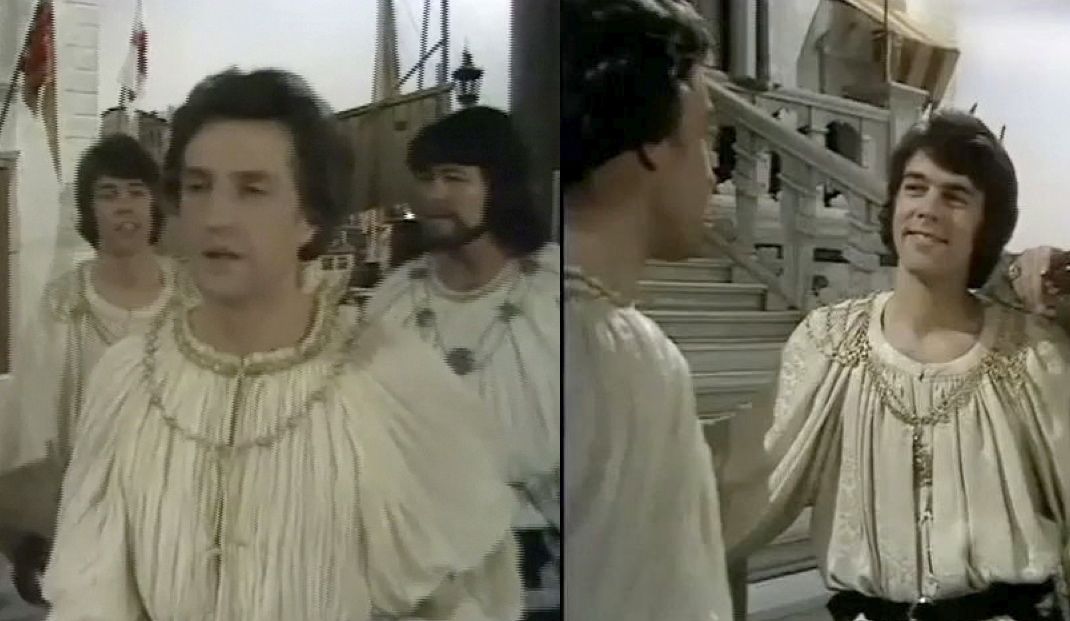
The first time Richard and I worked together was in a BBC TV 
production of The Merchant of Venice. I played Lorenzo and he Solanio.

I do not recall from 1986 that we discussed the relationship of officer and batman in the trenches as it developed into man-about-town and gentleman’s gentleman, amateur sleuth and technical assistant. The books had given us chapter and verse and we seemed to come to an understanding, a modus vivendi by some process of osmosis. We developed a supreme tact between us. I remember something about Richard that seemed reliable, benign, with always the twinkle of a possible smile.

Here is just a handful of our scenes together. In the one in which I am tying my bow tie, I remember we made up most of our dialogue.